1.6 sec in total
100 ms
879 ms
632 ms
Visit haskell.org now to see the best up-to-date Haskell content for Brazil and also check out these interesting facts you probably never knew about haskell.org
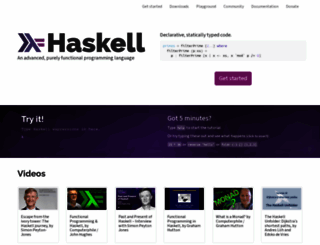
The Haskell purely functional programming language home page.
Visit haskell.orgWe analyzed Haskell.org page load time and found that the first response time was 100 ms and then it took 1.5 sec to load all DOM resources and completely render a web page. This is quite a good result, as only 30% of websites can load faster.
haskell.org performance score
name
value
score
weighting
Value3.5 s
34/100
10%
Value6.8 s
7/100
25%
Value3.5 s
88/100
10%
Value10 ms
100/100
30%
Value0.094
91/100
15%
Value5.1 s
75/100
10%
100 ms
146 ms
212 ms
61 ms
124 ms
Our browser made a total of 40 requests to load all elements on the main page. We found that 78% of them (31 requests) were addressed to the original Haskell.org, 15% (6 requests) were made to I1.ytimg.com and 5% (2 requests) were made to Cdn.jsdelivr.net. The less responsive or slowest element that took the longest time to load (299 ms) relates to the external source Static.scarf.sh.
Page size can be reduced by 395.4 kB (38%)
1.0 MB
645.6 kB
In fact, the total size of Haskell.org main page is 1.0 MB. This result falls beyond the top 1M of websites and identifies a large and not optimized web page that may take ages to load. 35% of websites need less resources to load. Images take 685.7 kB which makes up the majority of the site volume.
Potential reduce by 51.9 kB
HTML content can be minified and compressed by a website’s server. The most efficient way is to compress content using GZIP which reduces data amount travelling through the network between server and browser. This page needs HTML code to be minified as it can gain 13.1 kB, which is 21% of the original size. It is highly recommended that content of this web page should be compressed using GZIP, as it can save up to 51.9 kB or 83% of the original size.
Potential reduce by 120.9 kB
Image size optimization can help to speed up a website loading time. The chart above shows the difference between the size before and after optimization. Obviously, Haskell needs image optimization as it can save up to 120.9 kB or 18% of the original volume. The most popular and efficient tools for JPEG and PNG image optimization are Jpegoptim and PNG Crush.
Potential reduce by 140.1 kB
It’s better to minify JavaScript in order to improve website performance. The diagram shows the current total size of all JavaScript files against the prospective JavaScript size after its minification and compression. It is highly recommended that all JavaScript files should be compressed and minified as it can save up to 140.1 kB or 72% of the original size.
Potential reduce by 82.6 kB
CSS files minification is very important to reduce a web page rendering time. The faster CSS files can load, the earlier a page can be rendered. Haskell.org needs all CSS files to be minified and compressed as it can save up to 82.6 kB or 83% of the original size.
Number of requests can be reduced by 6 (16%)
37
31
The browser has sent 37 CSS, Javascripts, AJAX and image requests in order to completely render the main page of Haskell. We recommend that multiple CSS and JavaScript files should be merged into one by each type, as it can help reduce assets requests from 7 to 1 for JavaScripts and as a result speed up the page load time.
haskell.org
100 ms
haskell.org
146 ms
www.haskell.org
212 ms
fonts.css
61 ms
hl.css
124 ms
glider.min.css
16 ms
glider.min.js
18 ms
jquery.js
135 ms
bootstrap.min.js
132 ms
home.js
130 ms
jquery.console.js
135 ms
tryhaskell.js
129 ms
tryhaskell.pages.js
158 ms
mqdefault.jpg
130 ms
a.png
299 ms
haskell-logo.svg
113 ms
haskell-uwu.png
169 ms
pattern.png
265 ms
bellroy.png
114 ms
bitnomial.png
115 ms
calabrio.png
115 ms
centralapp.png
144 ms
e-bot7.png
145 ms
finn.png
143 ms
fission.png
144 ms
foxhoundsystems.png
173 ms
hasura.png
174 ms
imagineai.png
174 ms
iohk.png
175 ms
mercury.png
197 ms
noredink.png
203 ms
scarf.png
204 ms
serokell.png
204 ms
stackbuilders.png
206 ms
EM-Horizontal-White.svg
226 ms
mqdefault.jpg
115 ms
mqdefault.jpg
124 ms
mqdefault.jpg
121 ms
mqdefault.jpg
122 ms
mqdefault.jpg
120 ms
haskell.org accessibility score
Names and labels
These are opportunities to improve the semantics of the controls in your application. This may enhance the experience for users of assistive technology, like a screen reader.
Impact
Issue
Buttons do not have an accessible name
Form elements do not have associated labels
Contrast
These are opportunities to improve the legibility of your content.
Impact
Issue
Background and foreground colors do not have a sufficient contrast ratio.
Navigation
These are opportunities to improve keyboard navigation in your application.
Impact
Issue
Heading elements are not in a sequentially-descending order
haskell.org best practices score
Trust and Safety
Impact
Issue
Does not use HTTPS
Includes front-end JavaScript libraries with known security vulnerabilities
Ensure CSP is effective against XSS attacks
General
Impact
Issue
Detected JavaScript libraries
haskell.org SEO score
Mobile Friendly
Make sure your pages are mobile friendly so users don’t have to pinch or zoom in order to read the content pages. [Learn more](https://developers.google.com/search/mobile-sites/).
Impact
Issue
Document uses legible font sizes
Tap targets are not sized appropriately
![]()
EN
![]()
EN
UTF-8
Language claimed in HTML meta tag should match the language actually used on the web page. Otherwise Haskell.org can be misinterpreted by Google and other search engines. Our service has detected that English is used on the page, and it matches the claimed language. Our system also found out that Haskell.org main page’s claimed encoding is utf-8. Use of this encoding format is the best practice as the main page visitors from all over the world won’t have any issues with symbol transcription.
haskell.org
Open Graph description is not detected on the main page of Haskell. Lack of Open Graph description can be counter-productive for their social media presence, as such a description allows converting a website homepage (or other pages) into good-looking, rich and well-structured posts, when it is being shared on Facebook and other social media. For example, adding the following code snippet into HTML <head> tag will help to represent this web page correctly in social networks: