I’ve been thinking about what to write in this post - or even whether to write it at all - for a long time. Bottom line is that I’m struggling to put Accessify to its best use and I’m after some ideas about what I can do to sort this out.
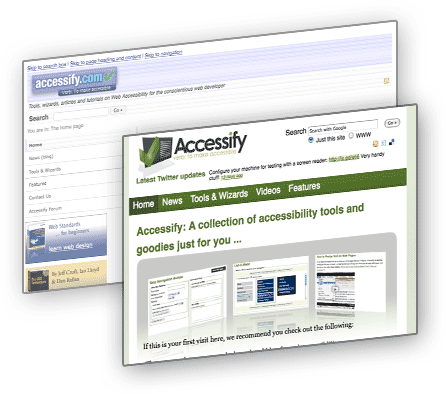
A few months ago I finally finished a redesign. That redesign (and rebuild) had been in the making for months itself and I thought that once it went live, with a new site structure and some new enthusiasm that the site may perk up a bit. Unfortunately, the problem I still have is finding the time to put in for it.
Unlike a lot of my peers in the accessibility world, I don’t spend an awful lot of my working time dealing with accessibility issues; it’s still very much a fringe issue during my day job. As such, I’m a bit out of the loop on the topic. When accessibility news comes in during the day, numerous other people will report it while I’m lucky if I even have Twitter switched on! In short - I miss lots of news and am left to simply repeat/re-tweet/re-hash or instead not bother because by the time I get to do anything with it, it’s hardly news. And in my free time … well, after my working day, I don’t spend the evening hours keeping up-to-date with ‘what’s hot’ in the world of accessibility! Life takes over (wife, dog, cooking, DIY, car maintenance etc) and I find that come 11pm all enthusiasm for doing something on this site has gone.
I had big ideas when I re-launched. I was going to do a range of video tutorials but it’s not happened:
- I was going to blog more (insert canned laughter here).
- I even had a Wiki on the sidelines, and totally reskinned it to fit in with the rest of the site. It really looks the part, but it’s not gone live because I realise that if I can’t keep on top of the ‘normal’ site, how the heck can I monitor Wiki activity?
So, what do I do? Things I’ve considered include:
- Sell Accessify on. There’s no ads on here (apart from those to my own books), so it’s not a revenue generator, but it could be worth something to someone
- Give it away to someone who I know will look after it
- Just leave it as-is, not worry about it. After all, does it really matter? In the grand scheme of things, should I be losing sleep over it?
Letting the site go seems drastic and, to some extent, wrong. This is the site I’ve had for the longest, it’s what I’m known for and back in the day (2002) it was one of only a handful out there doing its part to promote accessibility. But if I let it go, it’s a bit like giving away my baby, albeit a baby I have neglected for some time!
I would like to see some activity on the site again. In the past I’ve asked if anyone would like to contribute, but that’s never really worked out as the people I have asked already have their own thing going. Perhaps I’ve asked the wrong people (in terms of their desire to contibute); I certainly know that they’ve been the right people in terms of their knowledge/capability!
So, folks, what should I do? Is there a way I can give the site a kick-start again be allowing others to pitch in? Would anyone be willing to help get the Wiki off the ground? If you have ideas, or would like to contribute, please add a comment here. It would be great to see some activity on the site again, but I just have to admit that I can’t give it the full level of attention that I’d truly like to.

 It was not long ago that we learnt of